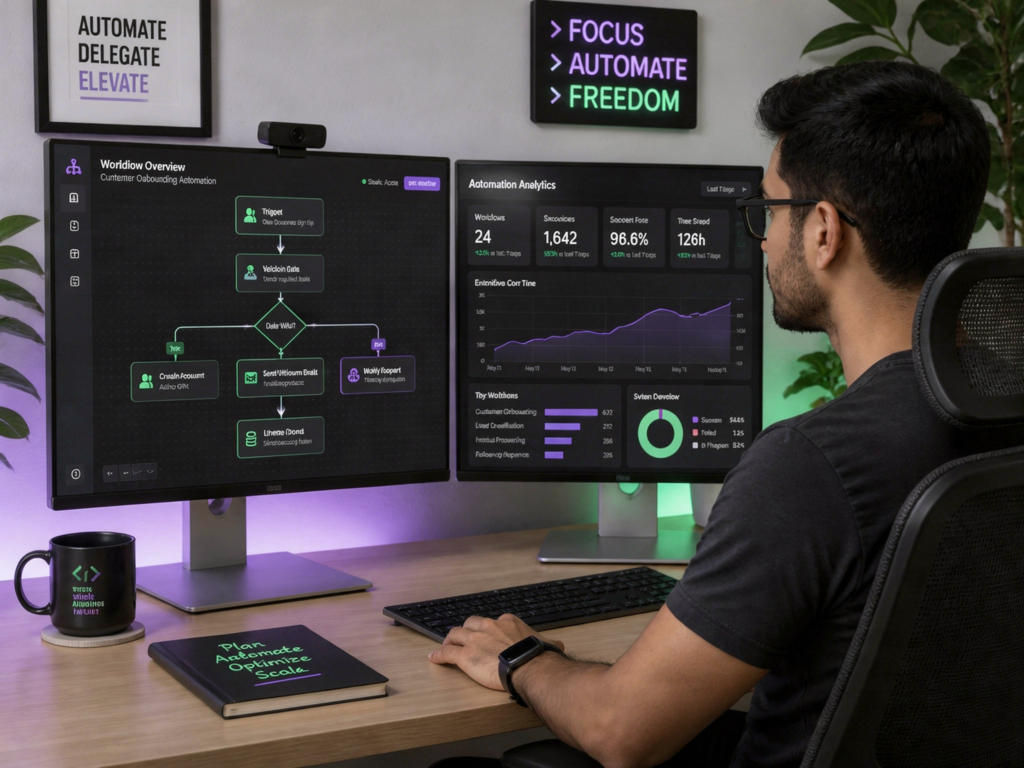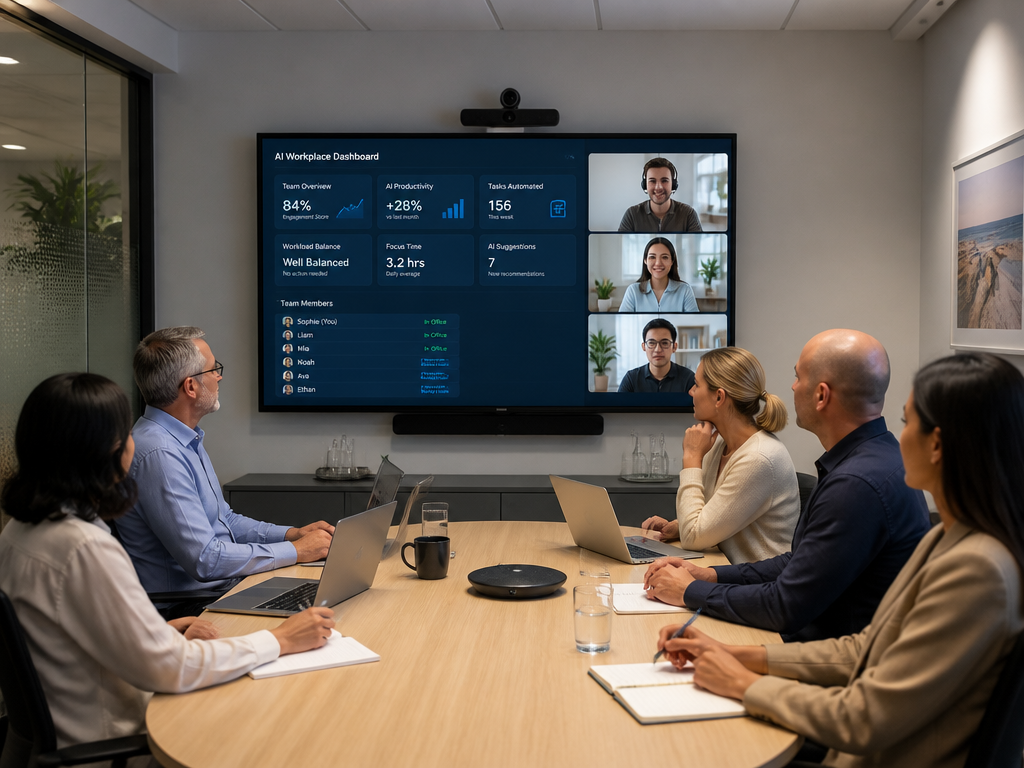
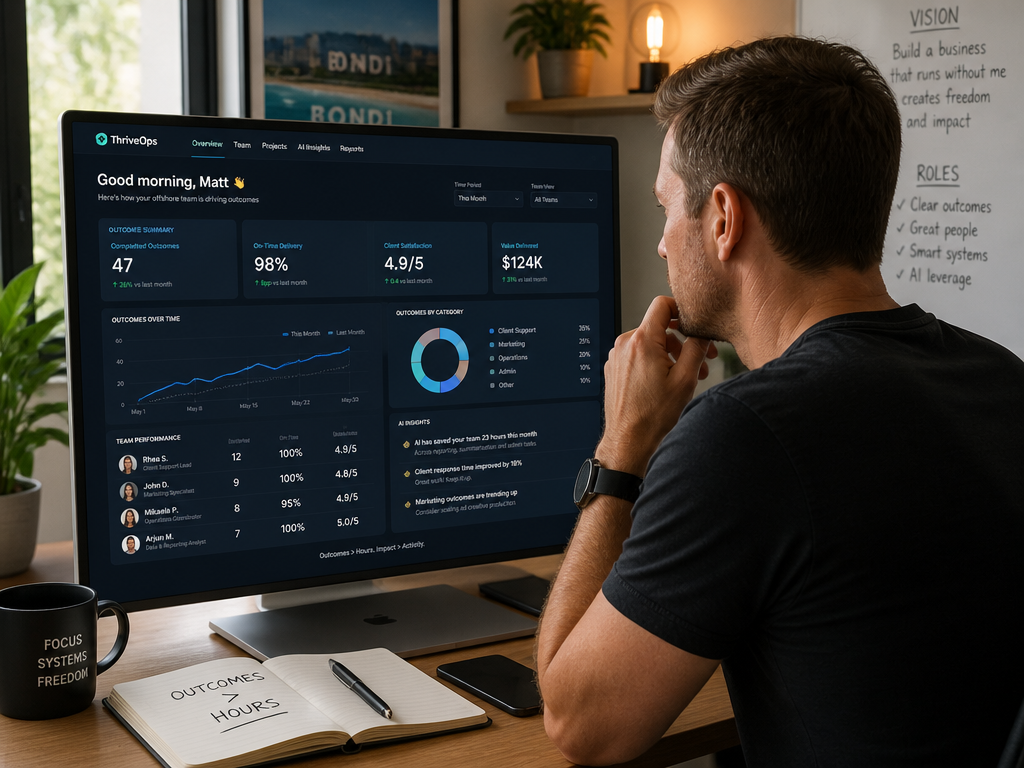
That model made sense when offshoring was about renting hands. It makes very little sense in 2026, when the actual work is being done by software half the time anyway.
The shift happening across Australian SMEs right now is quieter than the AI hype suggests, but more importantly: paying for outcomes instead of hours. The teams making this shift are running AI-integrated offshore workflows where productivity has decoupled from time-on-task. The teams that aren’t are watching their per-deliverable costs creep up while their competitors’ costs fall.
Here’s how the model works, what the data actually shows, and how to think about restructuring your own offshore arrangement around it.
Key Takeaways
- Hours stopped meaning output. Productivity gains of 10–25% are now standard in typical knowledge tasks like writing, researching, or programming, with AI shortening processing times and increasing quality simultaneously.
- The productivity J-curve has arrived. US productivity grew roughly 2.7% in 2025, nearly double the 1.4% annual average of the past decade — economists now attribute much of this to AI adoption.
- Outcome-based work is measurable. In controlled trials, developers using AI coding assistants completed tasks 55% faster, with code quality unchanged and pull request cycle time falling from 9.6 days to 2.4 days.
- The HITL framework is the safeguard. AI handles the data-heavy execution; the offshore professional handles judgement, nuance, and quality assurance — and prevents the speed-without-quality trap.
- Australian SMEs gain twice over. Outcome-based offshoring delivers enterprise-grade output without enterprise-grade headcount, and aligns provider incentives with your business goals rather than against them.
What “Outcome-Based” Actually Means
Outcome-based offshoring is a workforce model where you pay for completed deliverables — closed tickets, drafted reports, reconciled accounts, deployed code — rather than for the hours spent producing them. It only works when the offshore team has AI deeply integrated into their workflow, because AI is what decouples output from time-on-task in the first place.
The shift sounds like a pricing change. It’s actually a measurement change, and the pricing follows.
1. The Core Difference: Decoupling Time From Output
To understand why outcome-based AI-integrated offshoring outperforms the traditional model, look at how the two measure success.
In traditional offshoring, software is a tool. You provide an offshore worker with an email client, a CRM, and maybe a generative AI subscription, and you pay them to operate those tools manually for eight hours a day. Output is strictly limited by how fast human hands can type.
In an AI-integrated workforce, time is no longer the primary metric — the deliverable is. AI sits inside the infrastructure as a continuous, silent partner:
- Autonomous prep. Before an offshore agent begins a task, integrated AI has already aggregated the data, run historical analyses, and generated a first-draft solution.
- Intelligent routing. The system reads the complexity of an incoming task and routes it to the offshore team member with the right expertise — no admin bottleneck, no wasted handoffs.
- Continuous QA. AI flags anomalies, inconsistencies, and outliers in real time, so quality assurance happens during the work rather than after it.
The hour your offshore agent spends on a task today produces materially more than the same hour did three years ago. Pricing models built around hourly billing don’t capture this. Outcome-based models do.
2. How Integration Delivers Measurable Efficiency
When AI is deeply embedded into offshore operations, the ceiling on human productivity lifts sharply. Human energy is preserved for high-value thinking — and “high-value” is measurable.
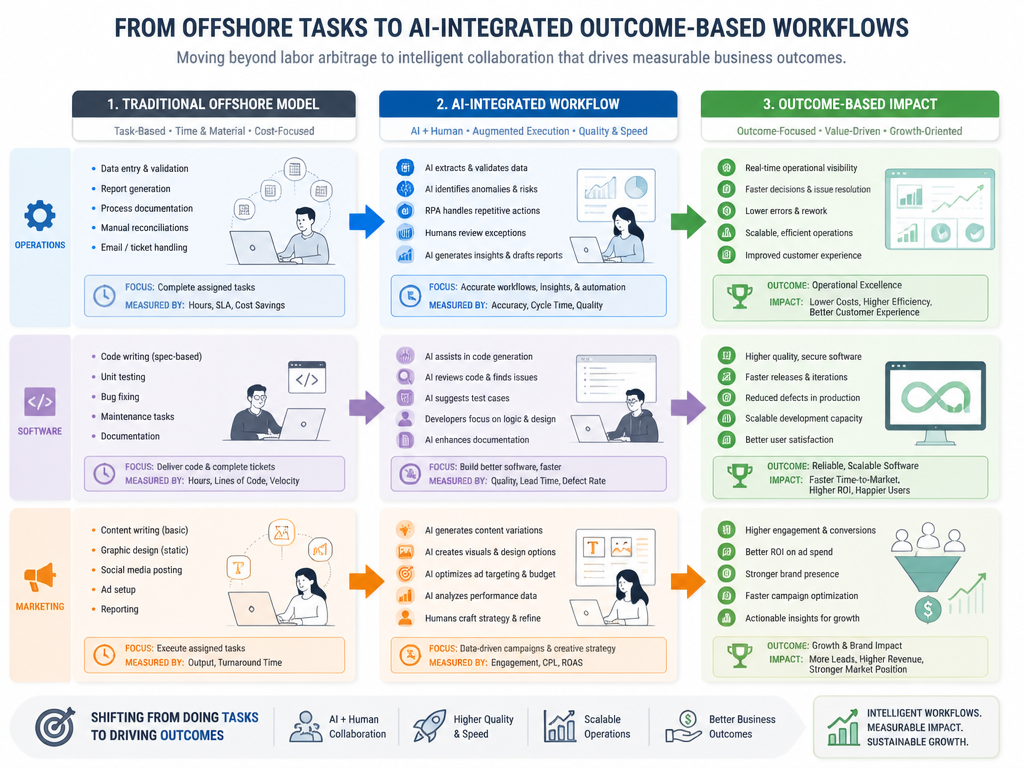
Operations and logistics. A traditional offshore dispatcher manually reads emails and updates spreadsheets across a standard shift. In an integrated model, AI reads the emails, maps supply chain delays in real time, and flags critical issues instantly. The offshore professional uses local market knowledge to negotiate solutions and manage vendor relationships — achieving in minutes what used to take hours.
Software engineering. Traditional offshore developers write boilerplate code from scratch. In integrated teams, AI continuously suggests, tests, and refines code in the background. The data is now well-established: controlled GitHub experiments showed developers using AI assistants completed tasks 55% faster — average task time fell from 2 hours 41 minutes to 1 hour 11 minutes — while pull request cycle time dropped from 9.6 days to 2.4 days, a 75% reduction. The human developer transitions into an architectural role, focused on logic, security, and scalability.
Digital marketing. Instead of an offshore assistant spending six hours manually pulling weekly analytics, the integrated AI system builds reports autonomously overnight. The offshore specialist arrives in the morning ready to implement strategic campaign adjustments — turning a full-day task into an immediate outcome.
These aren’t marginal gains. Studies show consistent performance gains of 10–25% in typical knowledge tasks, with AI shortening processing times while maintaining or improving quality.
3. The Safeguard: Human-in-the-Loop (HITL) Quality Assurance
The fastest way to fail with AI is to let it run completely unsupervised. The AI-integrated workforce model works because it relies on the Human-in-the-Loop (HITL) framework.
This isn’t theoretical. One recent global survey of 2,500 knowledge workers and IT decision-makers warned that “productivity and capability are not the same thing — you can get faster without getting better,” and that AI is delivering measurable speed gains alongside real concerns about eroded skills, judgement, and accountability when used without oversight.
The HITL model is the answer. AI delivers high-volume data processing and consistency at scale. The offshore professional delivers empathy, cultural nuance, strategic foresight, and rigorous quality assurance. The combination produces work that is fast and usable, brand-safe, and accurate for the Australian market.
What to Measure Instead of Hours
If you’re shifting your offshore arrangement to outcome-based, you need new KPIs. These are the ones working best for Australian SMEs in 2026:
- Cost per deliverable. Not cost per hour. Track what it costs to close a ticket, produce a report, reconcile a month-end, ship a feature.
- Cycle time. How long from request to completion. AI-integrated teams should be measurably faster — that’s the point.
- Quality rate. Percentage of deliverables that pass QA on the first review. Speed without quality is worse than slow-and-correct.
- Decision velocity. How quickly your team can act on offshore-produced output. A perfect report that arrives a week late is a bad outcome.
- Strategic time recovered. How many hours per week your onshore team gets back to focus on high-value work. This is the hidden compounding return.
Common Pitfalls to Avoid
The transition to outcome-based AI-integrated offshoring is powerful, but not plug-and-play:
- Confusing speed with capability. AI can make a mediocre worker faster at producing mediocre output. Hire for judgement first, AI fluency second.
- Skipping the workflow redesign. Bolting AI onto existing hourly-billed processes won’t deliver outcome-based results. The workflow itself needs to change.
- Ignoring data security. Closed, enterprise-grade AI environments are non-negotiable. Confirm compliance with the Australian Privacy Principles under the Privacy Act 1988.
- Pricing the transition wrong. Don’t lock in outcome-based contracts before you’ve established baseline metrics. You need 60–90 days of data to set fair deliverable pricing.
The Shift: Traditional Offshoring vs. The AI-Integrated Workforce
| Metric | Traditional Offshoring Model | AI-Integrated Workforce Model |
| Primary value metric | Hours worked (labour arbitrage) | Outcomes generated (exponential output) |
| Operational focus | Manual execution of repetitive tasks | Managing automated systems and refining outputs |
| Technology role | Software used as a manual, siloed tool | AI structurally embedded into the core workflow |
| Output scaling | Linear (more hires to do more work) | Multiplied (one worker manages multiple AI processes) |
| Error management | Prone to human fatigue and oversight | AI flags anomalies; humans verify solutions |
| Provider incentive | Bill more hours | Deliver more outcomes |
| Time-to-value | Months of ramp-up | Weeks, with continuous learning thereafter |
Frequently Asked Questions
Augmentation relies on human initiation — a staff decides to open an AI tool to help write an email faster. Integration relies on system initiation — the CRM’s built-in AI automatically drafts the email based on user behaviour triggers, and the offshore worker reviews, refines, and approves it. Integration produces compounding gains; augmentation produces individual ones.
No, provided it’s deployed correctly. Enterprise-grade integrated AI operates within closed ecosystems where proprietary business data is compartmentalised and used exclusively for your internal workflows — walled off from public AI models. Always confirm compliance with the Australian Privacy Principles under the Privacy Act 1988 before signing with a provider.
Fully autonomous AI lacks contextual judgement, cultural empathy, and the ability to pivot strategy when nuanced problems arise. It also hallucinates, sometimes in ways that aren’t obvious until the damage is done. The offshore professional acts as the human-in-the-loop, ensuring output is accurate, on-brand, and aligned with complex human expectations.
Most Australian SMEs can stand up an initial AI-integrated offshore function in four to eight weeks. Full optimisation takes three to six months as the AI learns your business patterns. The transition is structural, not catastrophic — but it does require leadership buy-in on rethinking workflows rather than just swapping providers.
Start with 60–90 days of baseline data using your existing setup. Measure cost per deliverable, cycle time, and quality rate. Then negotiate outcome pricing at a target that reflects realistic AI-integrated productivity gains (typically 25–55% faster on routine knowledge tasks, based on current research). Build in quality thresholds so speed alone doesn’t trigger payment.
Software development, content production, customer support ticket resolution, bookkeeping reconciliation, and data operations. Each has clear, countable deliverables and well-documented AI productivity benchmarks. Roles with subjective or relationship-based outputs (strategy, account management, sales) are harder to convert and usually stay on retainer or hourly models.
Scale Smarter With Hyvid
Clinging to hourly offshore billing in 2026 isn’t a saving — it’s a structural disadvantage. To achieve real operational efficiency, you need more than remote workers. You need an infrastructure where human talent and AI operate as one cohesive unit, and a pricing model that rewards both you and the provider for moving faster, not slower.
At Hyvid, we build modern AI-integrated workforces for Australian businesses. Our offshore professionals are pre-trained in managing, optimising, and operating alongside advanced AI systems — and we structure engagements around outcomes, not seat-time.
Book a 30-minute strategic consultation and we’ll map your current offshore spend by deliverable, identify the highest-leverage processes to convert to outcome-based work, and show you the cost-per-deliverable improvement available for a business your size.