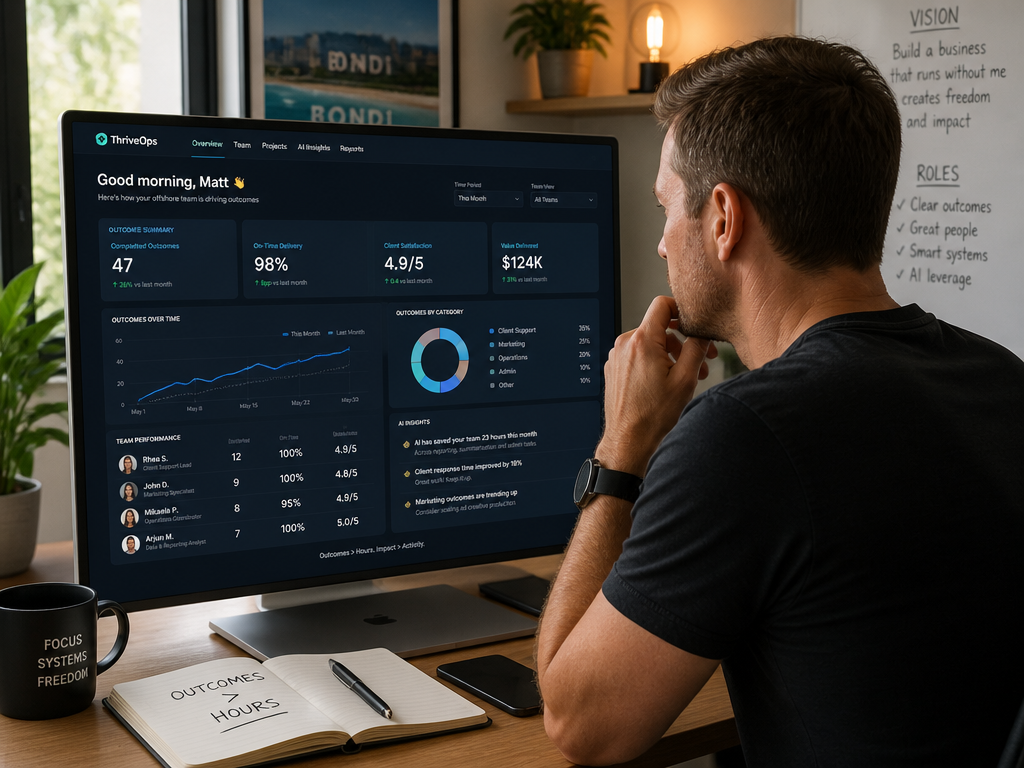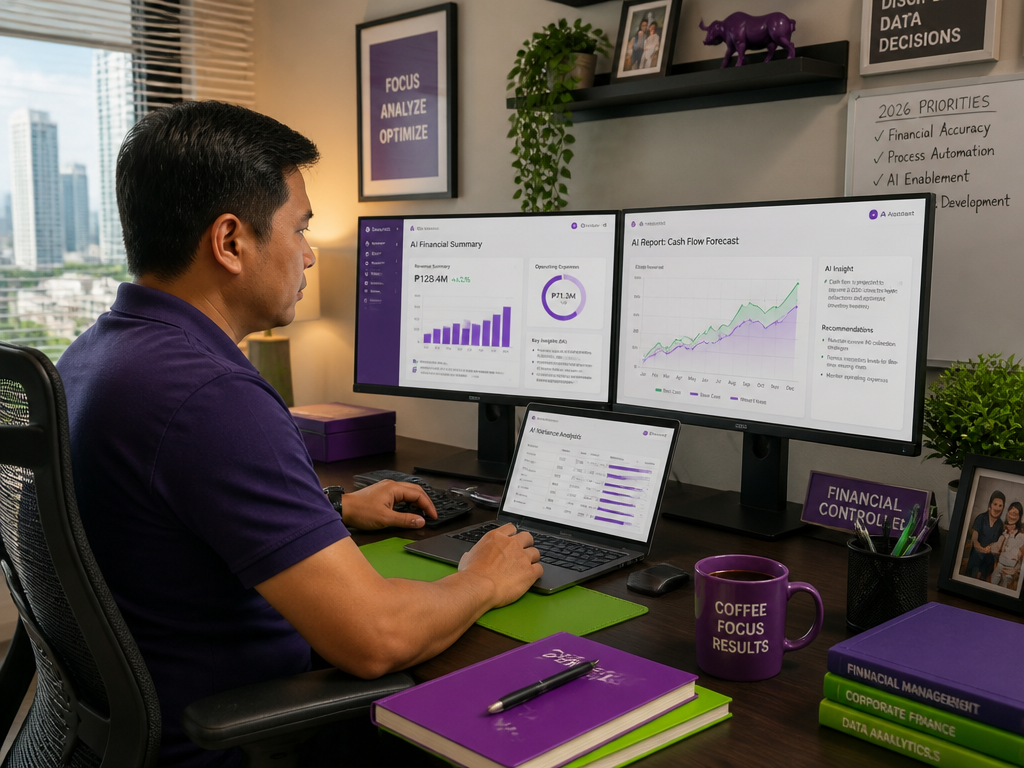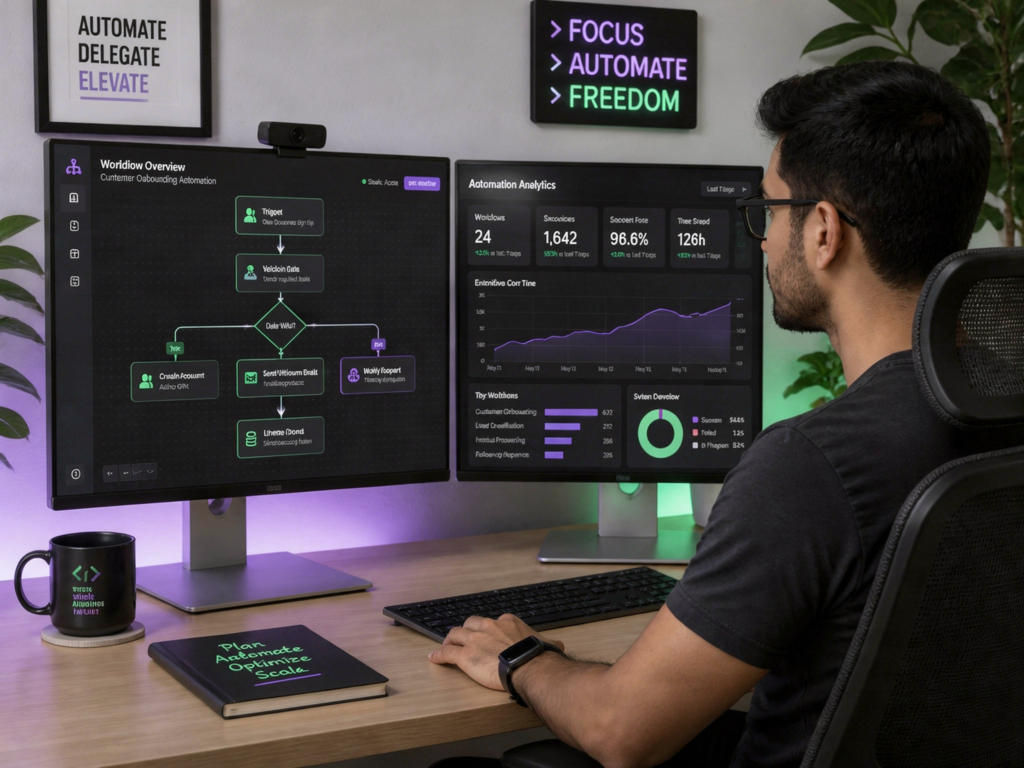
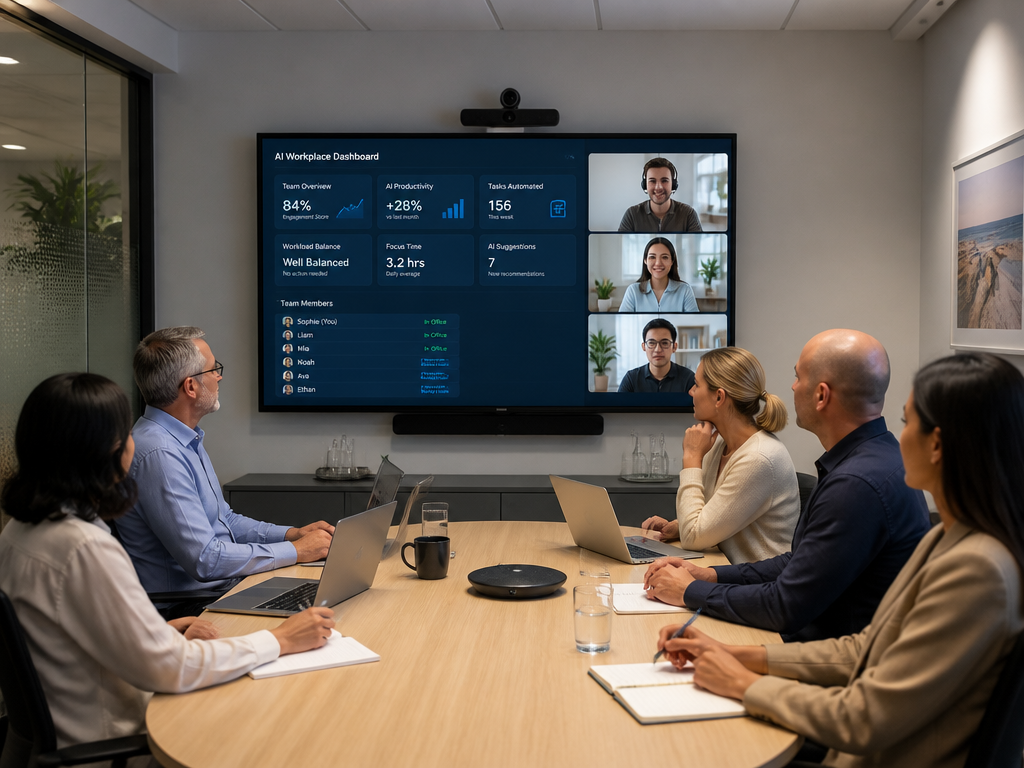
The difference is critical. AI is no longer a shiny tool or a “copilot” that an offshore worker occasionally logs into. Today, artificial intelligence is structurally woven into the very fabric of global team workflows. It operates alongside human talent as a silent, continuous partner inside the infrastructure itself.
This shift could not come at a more important time for Australia. According to the Jobs and Skills Australia Occupation Shortage List released in October 2025, approximately 29% of assessed occupations are experiencing skills shortages, with acute demand in healthcare, technology, construction, and education. Meanwhile, offshore hiring can deliver up to 80% cost savings while unlocking access to global talent pools in the Philippines, India, and Sri Lanka, making AI-integrated offshoring not a luxury, but a survival strategy for SMEs from Sydney to Perth.
Here is how this deep integration is transforming global teams, and how your business can capitalise on it.
Key Takeaways
- Beyond cost savings: Offshoring in 2026 has evolved from cheap labour to exponential output density through embedded AI workflows.
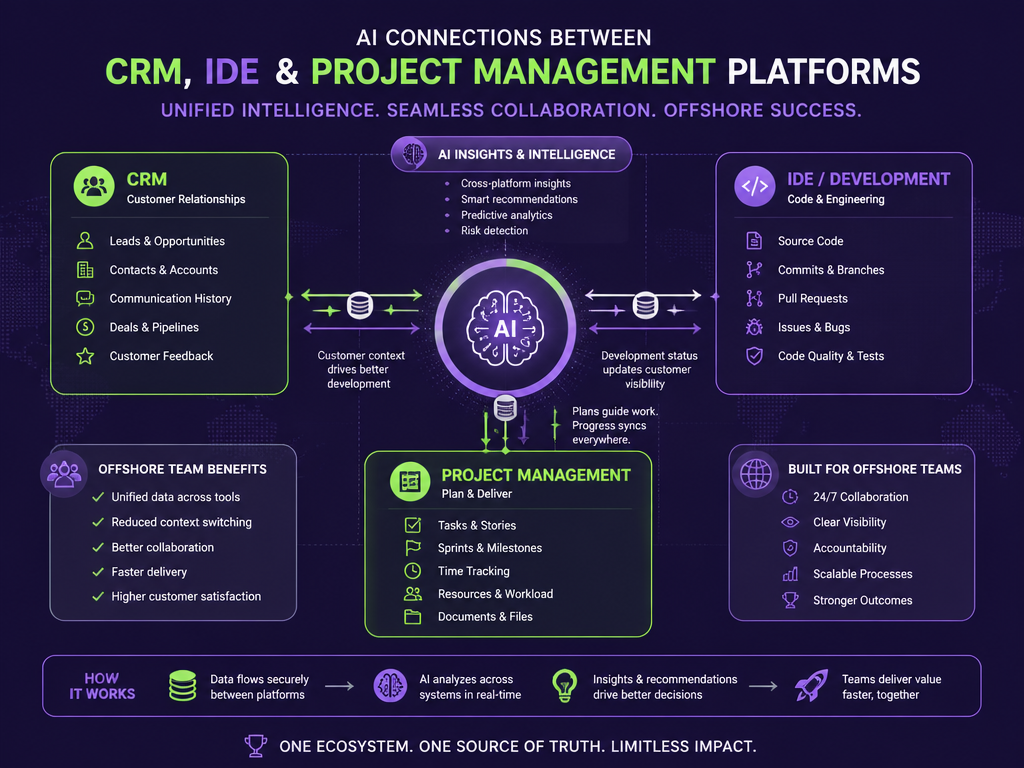
- Deep integration: AI is no longer a separate tool; it is baked directly into project management, IDEs, and CRM platforms to automate the heavy lifting.
- The symbiotic workforce: Offshore talent and AI work together. AI handles data and initial execution; humans manage strategy, quality assurance, and empathy.
- Eradicating friction: Embedded AI systems automatically translate cultural nuances and manage time-zone handoffs with Australian onshore teams.
- Backed by data: 91% of businesses report using AI in at least one capacity in 2026, but only those embedding it deeply into workflows see real productivity gains.
What Is AI-Integrated Offshoring?
AI-integrated offshoring is a workforce model in which artificial intelligence is built natively into the systems an offshore team uses automating data processing, drafting, routing, and quality checks so that human professionals can focus on judgement, strategy, and client relationships.
This is distinct from AI-augmented offshoring, where individual workers manually use AI tools on the side. Integration is structural; augmentation is optional.
1. From “Tool Usage” to Deep Workflow Integration
Historically, companies provided their offshore teams in hubs like the Philippines or India with software subscriptions and expected them to figure it out. In 2026, successful businesses build bespoke, AI-integrated pipelines where human effort and machine processing are perfectly synchronised.
The result is measurable. Reports found that 60% of enterprises recover their automation investment within 12 months, with ROI driven by 25–30% productivity gains and 40–75% error reductions. When AI is embedded directly into the platforms your team uses daily, output density rises sharply:
- Embedded customer success: AI is integrated into the CRM, analysing a customer’s history in milliseconds, routing the ticket to the most appropriate offshore agent, and auto-generating a draft response matched to your brand’s tone.
- Continuous development pipelines: Offshore engineering teams work within IDEs where AI runs automated code reviews and security patches in the background, freeing human developers to focus on architecture and complex logic.
- Synchronised marketing: Content ecosystems are fully embedded. AI analyses Australian search trends, generates content briefs, and builds localised outlines directly inside the project management software, queued for your offshore creative team to execute.
Gartner predicts 40% of enterprise apps will embed task-specific agents by 2026, a trend that makes this kind of native integration the new baseline, not a competitive edge.
2. Closing the Cultural Gap With Embedded Systems
One of the largest historical pain points for Australian SMEs working with offshore providers was friction in communication and cultural alignment. AI integration has all but eliminated this by operating invisibly inside communication channels.
- Contextual alignment in real time: Embedded AI inside Slack and Microsoft Teams does not simply translate language,it translates Australian business nuance. The system gently flags potential miscommunications or reframes instructions to ensure clarity between onshore management and offshore execution.
- Automated workflow handoffs: Even the modest time-zone gap between Australia and Southeast Asia is neutralised. AI agents automatically summarise the Australian workday, organise next steps, and brief the offshore team the moment they log in, so no momentum is lost between shifts.
3. The Symbiotic Workforce: Systems, Not Silos
The most successful Australian businesses in 2026 have abandoned the idea of “human tasks” versus “AI tasks.” Instead, they run a symbiotic workforce.
In this model, technology handles the heavy lifting of data processing, pattern recognition, and initial drafting, while the offshore professional provides the critical thinking, emotional intelligence, and final quality assurance. The system learns from the human’s corrections, creating a continuous feedback loop that makes the entire business smarter every single day.
This pairing is now backed by hard evidence. Sectors where AI complements human labour see productivity up around 10%, job growth of around 3.9%, and wage increases of around 4.8% outcomes that pure-replacement strategies consistently fail to match.
Traditional Offshoring vs. AI-Integrated Offshoring (2026)
| Feature | Traditional Offshoring | AI-Integrated Offshoring |
| Role of technology | Software used as a manual tool | AI baked into the core workflow |
| Primary benefit | Lower hourly wage costs | Structural, exponential scalability |
| Data & knowledge | Siloed in individual workers’ heads | Systematised and continuously learned by the AI |
| Output volume | Linear (1x output per worker) | Multiplied (systems execute while humans guide) |
| Australian alignment | Required heavy cultural training | Embedded AI bridges context automatically |
| Time-to-value | 3–6 months onboarding | Weeks, with continuous learning thereafter |
Common Pitfalls to Avoid
AI-integrated offshoring is powerful, but it is not plug-and-play. An MIT study shows that 95% of enterprise generative AI pilots fail to deliver measurable financial impact — the problem is not the technology itself but poor integration with existing workflows. Watch for these common mistakes:
- Treating AI as a replacement, not an amplifier. Teams that strip out human oversight see quality collapse within months.
- Skipping change management. Offshore staff need clear protocols for when to override the AI and when to defer to it.
- Using public AI tools with sensitive data. Always insist on closed, enterprise-grade environments.
- Measuring the wrong KPIs. Track output quality and customer outcomes, not just task volume.
Frequently Asked Questions
AI-augmented offshoring means a human is actively choosing to use an AI tool (for example, logging into ChatGPT to write an email). AI-integrated offshoring means the artificial intelligence is built directly into the company’s backend workflows — acting autonomously to prepare data, route tasks, and draft content before a human even steps in.
No. While AI handles data processing and initial task execution well, it lacks nuanced judgement, cultural empathy, and strategic foresight. The future relies on a symbiotic workforce where offshore professionals guide, refine, and quality-check AI outputs.
Australia faces high domestic operational costs, a competitive local market, and a documented skills shortage across nearly a third of all assessed occupations. To scale profitably, businesses need high output without proportional overhead. AI-integrated offshoring delivers enterprise-level productivity at a fraction of the cost, keeping Australian SMEs globally competitive.
Yes, provided the right infrastructure is in place. Modern AI-integrated offshore teams use closed, enterprise-grade AI environments where data is securely compartmentalised, ensuring proprietary information is never used to train public language models. Look for partners that comply with the Australian Privacy Principles (APPs) under the Privacy Act 1988.
Most SMEs can stand up an initial AI-integrated offshore function within four to eight weeks, depending on the complexity of existing systems. Full optimisation typically takes three to six months as the AI learns the business’s specific patterns and standards.
Customer support, software development, content production, bookkeeping, virtual assistance, data operations, and digital marketing are the strongest fits. Any role that combines repetitive data work with a layer of human judgement benefits from this structure.
Scale Smarter With Hyvid
Transforming your workforce should not mean tearing down your business to install new software. To future-proof your operations and build an AI-integrated offshore team that outpaces your competitors, you need the right structural partner.
At Hyvid.com, we connect forward-thinking Australian businesses with top-tier global talent, embedded seamlessly into AI-driven workflows. We do not just find you people; we build robust, intelligent systems where human ingenuity and embedded AI operate as one cohesive unit.
Book a 30-minute strategic consultation and we will map your current workflows, identify the highest-leverage roles offshore, and show you exactly how AI integration would lift output in your business at no cost and no obligation.