Quick answer: AI is not replacing offshore staff; it is changing what they do. Routine, repetitive tasks are being automated while offshore professionals move into roles operating, supervising and improving AI-enabled workflows. PwC’s 2026 research shows roles reshaped by AI around human judgement growing twice as fast and paying more than those it simplifies, and the Philippine industry is rebuilding itself around exactly that shift.
That is the thesis. It deserves scepticism, because ‘AI will make everyone more valuable’ is exactly what an offshore staffing company would say. So let us argue it properly, starting with the part of the fear that is true.
Is offshoring dead because of AI?
A particular kind of offshoring is dying: the kind that sold human time to perform routine, rules-based tasks. Offshoring built on judgement, context and AI-supervised output is growing. The question is not whether to use offshore talent, but which model you are buying.
Be honest about what AI now does well. Data entry, basic transcription, first-pass document processing, simple ticket responses, standard reconciliation: the tasks that filled millions of entry-level outsourcing seats are increasingly automatable. Any offshore arrangement whose entire value is a person performing a repetitive digital task cheaply is competing directly with software, and software is winning on price.
The offshore industry itself has stopped pretending otherwise. In July 2026, the Philippine IT-BPM industry association IBPAP revised its 2028 roadmap targets downward from the original $59 billion and 2.5 million workers, citing AI adoption, shifting buyer behaviour and global competition as the drivers. That is a major industry openly acknowledging that its old growth model, more seats performing more tasks, has ended.
But read what the same association said next, because it is the whole story in one sentence. Its stated vision is now an industry powered by two million AI-enabled digital Filipino workers, with the emphasis, in its own words, on AI-enabled rather than the number. IBPAP’s updated scenarios make the fork explicit:
- Best case: revenue exceeding $50 billion by 2028 with 2.14 million AI-enabled workers
- Downside, if the sector fails to adapt to AI: revenue stalling near $43 billion and employment falling to 1.85 million
- Meanwhile the industry still expects to close 2026 at $42.3 billion and 1.96 million workers, up from $40 billion and 1.89 million in 2025
Growth continues. What changed is who captures it: workers and providers on the AI-enabled side of the line.
What happens to BPO jobs as AI improves?

They split into two tracks: roles AI simplifies shrink in value and volume, while roles AI amplifies around human judgement grow faster and pay more. The evidence for this split is now global and quantified.
PwC’s 2026 Global AI Jobs Barometer, built on more than one billion job advertisements across 27 countries, describes exactly this bifurcation:
- Jobs professionalised by AI, where the technology magnifies expert judgement, are growing at twice the rate of jobs it merely simplifies, with 42% faster wage growth since 2021
- Skills in the most AI-exposed jobs are changing more than twice as fast as in the least exposed
- Productivity growth is 40% higher at the companies most exposed to AI
Map that onto offshore work and the picture is precise. The shrinking track is transactional: routine data processing, scripted support, document handling performed as isolated tasks. The growing track is supervisory and analytical: professionals who run AI-assisted workflows end to end, verify and correct machine output, handle the exceptions automation cannot, and improve the process as they go.
Notably, PwC’s headline finding cuts against the apocalypse narrative: companies making the biggest AI-driven productivity gains are raising wages and headcount faster than companies least exposed to AI. AI-heavy operations are hiring more people, not fewer. They are just hiring for different work.
Why are AI-skilled offshore workers in higher demand?
Because the market now pays a large, measurable premium for people who combine AI tools with professional judgement, and offshore professionals who fit that profile deliver the premium skill set without the premium price.
The numbers are striking. According to the same PwC research:
- Jobs requiring AI skills grew 69% in 2025, nearly eight times faster than the overall jobs market at 9%
- The average wage premium for AI skills reached 62%, up from 57% the year before
In Australia, that premium makes AI-capable local hires scarcer and more expensive at exactly the moment SMEs need the capability most.
This is where the offshore equation quietly inverted. Offshore talent was historically the budget option for routine work. AI flips the value proposition: the Philippine industry is investing heavily in AI upskilling across a workforce of nearly two million, precisely to supply the judgement-plus-AI profile the global market is repricing upward. For an Australian SME, an AI-equipped offshore professional is no longer a cheaper way to buy routine tasks. It is an affordable way to buy the most in-demand worker profile of 2026.
One caveat belongs here, because thought leadership without caveats is marketing. The premium attaches to genuinely AI-skilled people inside well-designed workflows, not to a line in a CV. An offshore provider claiming AI-enabled status should be able to show you the training curriculum, the tools, and the workflow design. The two-track data cuts both ways: it rewards the real thing and punishes the label.
What does this mean for how you build a team?
It means hiring for the growing track: people whose roles are structured around operating, supervising and improving AI-enabled work, rather than performing tasks AI will absorb. Three design choices follow from the evidence:
- Buy judgement, not tasks. If a role can be fully described as a repeatable task list, price it against software, because the market will. Structure offshore roles around ownership of outcomes, exceptions and quality.
- Treat AI capability as a hiring criterion, not an add-on. The 62% premium exists because the skill combination is scarce. Providers who train for it systematically are supplying tomorrow’s baseline.
- Expect roles to keep moving. With skills in AI-exposed jobs changing at more than twice the normal rate, the team you build needs a training rhythm, not a one-off induction.
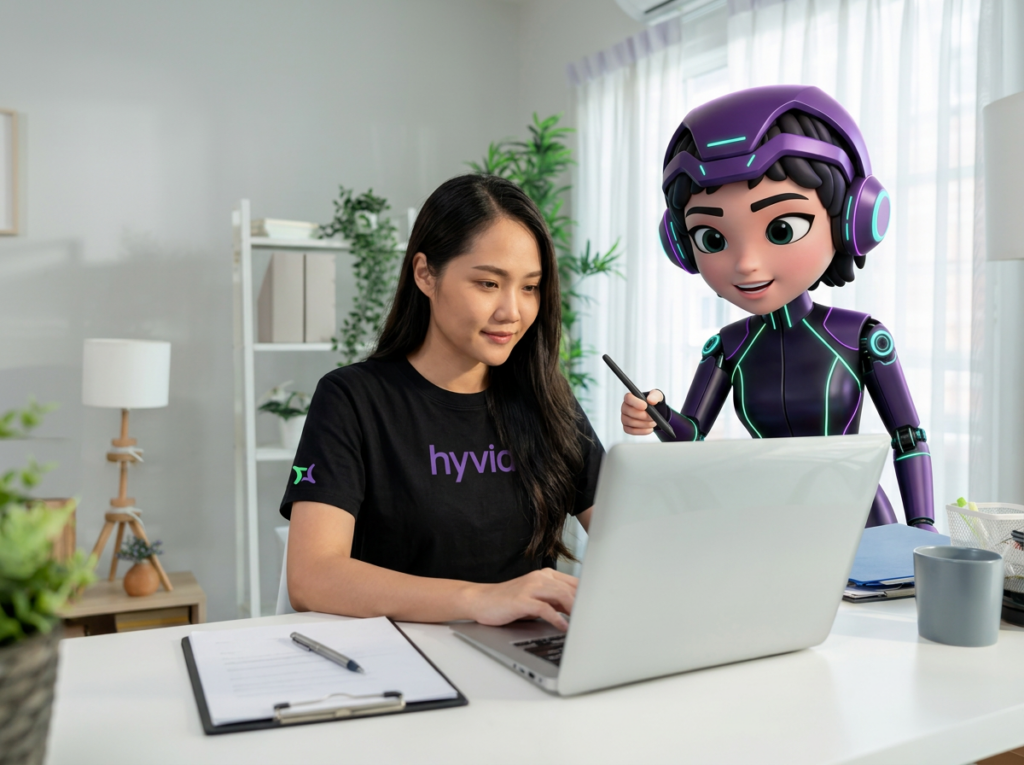
This is the model Hyvid builds by default: every team member operates as part of a human and AI unit, trained on the tools and structured around the judgement work that AI cannot absorb. The replacement question, in the end, has the same answer at every level. AI replaces tasks, and revalues people. The offshore professionals rising in value are the ones repositioned around what AI cannot do, and that is how Hyvid builds AI-ready teams.
Frequently Asked Questions
AI keeps absorbing more of the routine layer, which is why roles are designed around a moving frontier: supervision, exceptions, accountability and client context. The two-track data shows judgement-centred roles growing as automation advances, not despite it.
The risk is provider selection, not the model. The Philippine industry is still growing through the transition, but the gap between AI-enabled providers and legacy seat-sellers is widening. Diligence the training, tools and workflow design before anything else.
The pattern in the data is that AI-exposed businesses grow headcount faster overall. In practice SMEs use offshore capacity to make local roles more senior and more strategic, the same reshaping AI drives everywhere.
Roles combining AI tools with domain judgement: accounts professionals supervising automated processing, support specialists owning complex resolutions, marketing professionals directing AI-assisted production, and QA and compliance roles verifying machine output.