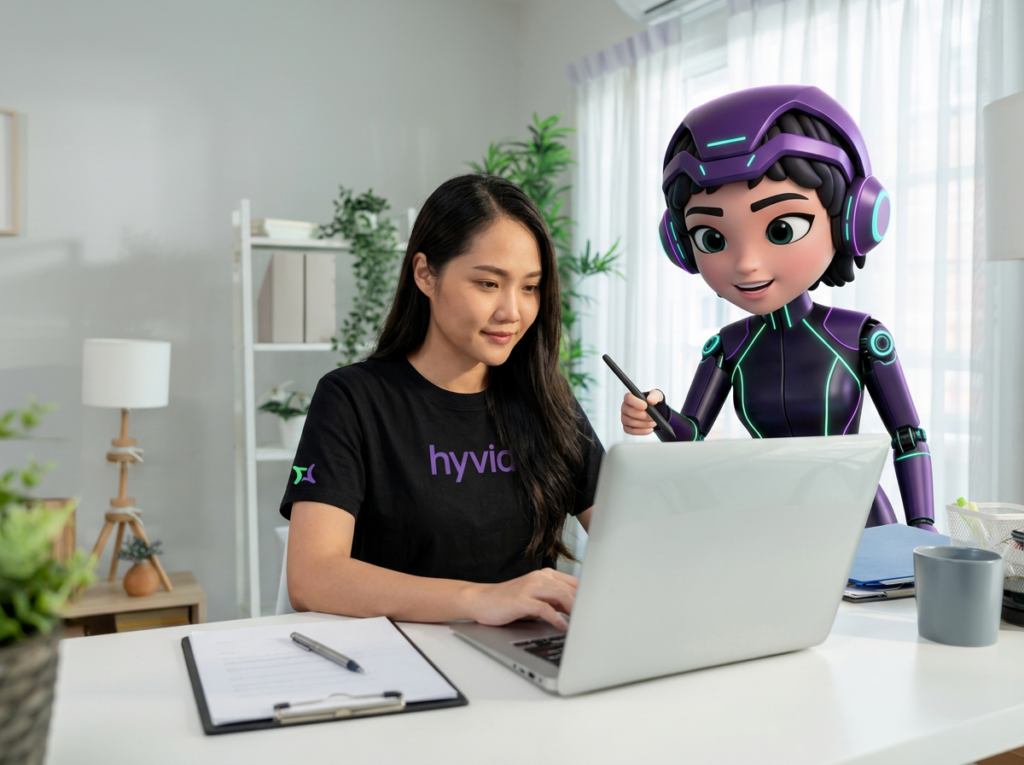
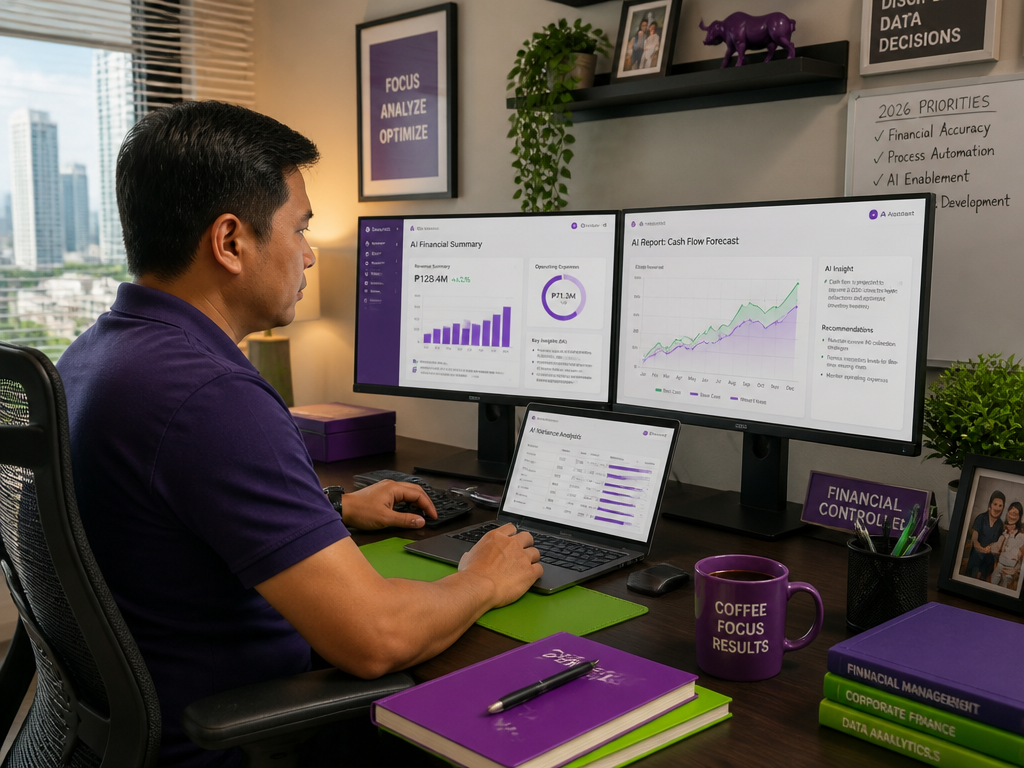
The low cost labour story has been quietly replaced by something more interesting. Across Manila, Cebu, and Clark, back-office teams are running enterprise AI tools alongside the work — auditing datasets, managing automated workflows, drafting financial models the AI generates, catching the things it gets wrong. The cost advantage is still there. But the output looks nothing like 2021.
For Australian SMEs trying to scale without bloating local headcount, this matters. The Philippines is no longer where you send cheap work. It’s where the engine room of your business actually lives.
Key Takeaways
- Unprecedented sector growth: The Philippine IT-BPM industry earned $40 billion in revenues and employed 1.9 million workers in 2025, with IBPAP projecting $42 billion in revenue and 1.97 million jobs in 2026.
- The $59 billion roadmap: The IT-BPM industry has set an aggressive target of generating $59 billion in revenue and employing 2.5 million by 2028.
- High AI adoption: An IBPAP survey shows that 67% of its IT-BPM member firms have incorporated AI tools into their operations — far ahead of global B2B averages.
- The shift from entry to integrity: Basic data entry roles have evolved. The Philippine workforce is upskilling into AI Data Integrity Specialists, Financial Analysts, and Workflow Orchestrators.
- Augmentation, not replacement: 67% of member companies have adopted AI technologies to improve service delivery and enable workers to focus on higher-value tasks requiring human judgement, empathy, and creativity.
What Is an “AI-Integrated Back Office”?
An AI-integrated back office is an outsourced administrative function — accounting, HR, IT, data operations — where AI tools are embedded into the workflow itself, handling the high-volume processing while skilled offshore professionals manage, audit, and refine the output.
This is not the same as a traditional BPO with AI bolted on. Integration means the AI runs continuously inside the systems the offshore team uses, not as an optional side tool.
The 2026 Philippine Back-Office Landscape by the Numbers
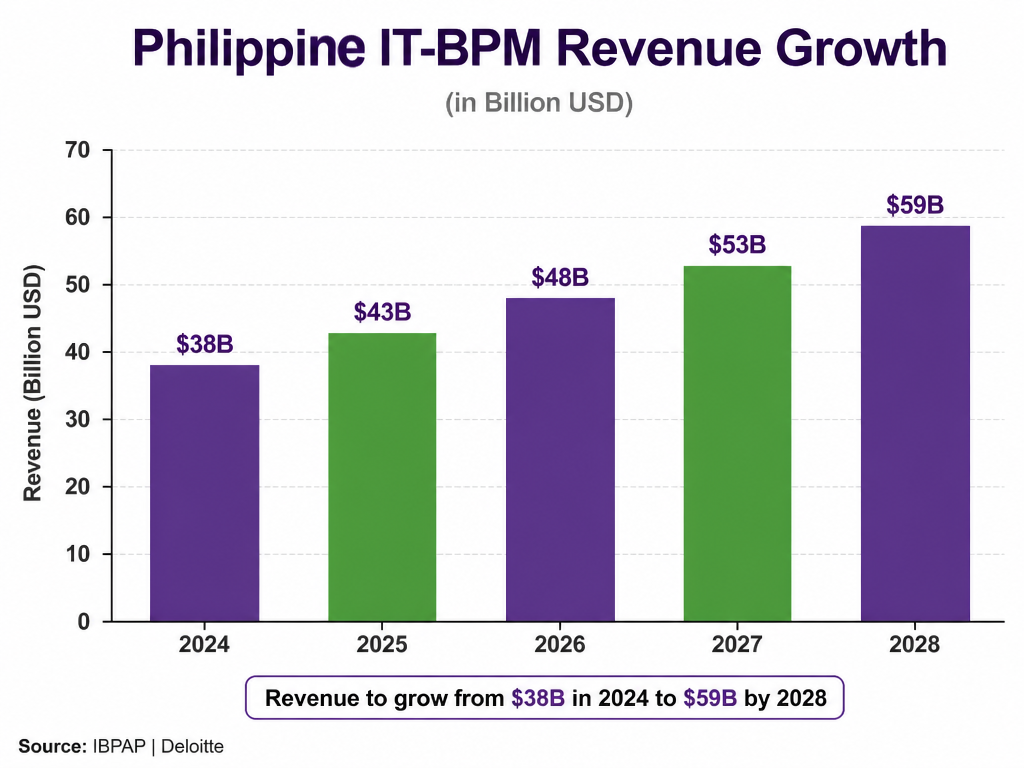
The Philippine outsourcing market didn’t shrink when AI hit the mainstream — it evolved and expanded. The IT-BPM sector now accounts for more than 8% of Philippine gross domestic product, and growth has consistently outpaced global benchmarks: the Philippine industry posted 5% revenue growth and 4% employment growth in 2025, compared with global IT-BPM growth of about 3%.
But the makeup of back-office revenue has fundamentally changed:
- The end of manual clerical work. Repetitive, rule-based tasks — manual ledger balancing, basic email sorting, simple copy-paste data entry — have largely been absorbed by generative AI and robotic process automation.
- The rise of the AI-augmented professional. With two-thirds of the industry integrating AI, the focus has shifted from headcount to value-per-employee. IBPAP notes rising demand for Filipino professionals in analytics, business intelligence, project and program management, transformation, and strategy roles.
- Strong adaptability. The Philippines consistently ranks in the top tier for technology and data adaptability. The back-office workforce has recognised that AI is a force multiplier, not a replacement.
The Upskilling Revolution: Upgrading the Engine Room
What makes the Philippines the strongest choice for Australian businesses in 2026 is how aggressively the talent pool has been upskilled. Both government initiatives and private sector investment have pivoted toward AI fluency in back-office and KPO sectors. IBPAP’s stated focus for 2026 is to relentlessly upskill the workforce, embrace higher-value work, and keep the Philippines at the heart of global services.
Filipino talent is being specifically trained to operate the tools that drive modern business operations:
- From data entry to data integrity. AI models are only as good as the data they process. A significant proportion of the Philippine administrative workforce is now dedicated to enterprise AI data training — cleaning, organising, auditing, and tagging the proprietary data Australian businesses use to train their internal systems.
- Financial analytics over basic bookkeeping. Philippine Certified Public Accountants (CPAs) and bookkeepers are leveraging AI to automate invoice processing and payroll, then using their freed-up time to provide predictive financial forecasting, cash flow analysis, and strategic advisory services.
- Automated workflow management. Administrative assistants have evolved into Workflow Orchestrators. They are trained to integrate tools like Zapier, Microsoft Copilot, and custom AI agents to ensure seamless data flow between an Australian company’s onshore team and offshore backend.
How to Integrate AI-Empowered Back-Office Talent
To get the best out of Philippine outsourcing today, Australian businesses must shift their operational blueprint. You are no longer hiring someone to manually process paperwork — you are hiring a professional to manage an automated system.
Here is how to integrate this upskilled talent into your existing processes:
Accounting and finance. Integrate your cloud accounting software’s AI capabilities with a Filipino financial controller. The AI instantly categorises expenses, flags anomalies, and drafts preliminary P&L statements. Your offshore accountant reviews the data for ATO compliance, refines the financial models, and provides strategic insights.
HR and recruitment support. Set up an integrated pipeline where AI tools scan resumes, schedule interviews, and draft onboarding documents. Your Philippine-based HR administrator acts as the quality assurance layer — managing the AI software, finalising candidate shortlists, and ensuring compliance with Australian labour standards under Fair Work guidelines.
IT support and cybersecurity. Pair mid-level offshore IT technicians with AI diagnostic tools. The AI monitors your network 24/7, instantly quarantining potential threats and generating incident reports. Your offshore IT professional analyses these reports, deploys advanced patches, and manages your overall tech infrastructure.
Common Pitfalls to Avoid
The transition is not plug-and-play. Watch for these recurring mistakes:
- Treating AI as a cost-saving tool rather than a workflow redesign. The biggest gains come from rebuilding processes around AI, not bolting it onto legacy ones.
- Underestimating the skills mismatch. The Philippine BPO industry faces a significant supply challenge: a shortage of workers equipped with technical skills or who can work with AI, with re-skilling and upskilling remaining a top priority. Vet providers carefully — not every BPO has caught up.
- Skipping data security review. Always insist on closed, enterprise-grade AI environments. Your provider should comply with the Australian Privacy Principles under the Privacy Act 1988.
- Measuring the wrong KPIs. Track output quality, error rates, and decisions accelerated — not just task volume or hours saved.
Traditional Back-Office vs. AI-Integrated Back-Office
| Feature | Traditional Philippine Back-Office (Pre-AI) | AI-Integrated Philippine Back-Office (2026) |
| Primary output | Manual data entry and repetitive task execution | System management, data auditing, and analytics |
| Pace of delivery | Linear (hours per task) | Exponential (seconds per task, minutes for QA) |
| Core worker skill | Basic software proficiency (Excel, Word) | AI fluency, software integration, critical thinking |
| Business value | Lower operational costs | High-level strategic output at a fraction of local costs |
| Integration level | Siloed, third-party vendor systems | Embedded directly into onshore enterprise tech stacks |
| Talent profile | Generalist administrative support | KPO-grade specialists (CPAs, analysts, orchestrators) |
What This Means for Australian SMEs
Three practical implications if you’re rebuilding your back office this quarter:
- Stop hiring “admin support.” Start hiring system operators. A job description listing “data entry, invoicing, scheduling” is already obsolete. Reframe it as “managing the AI workflows that handle invoicing, scheduling, and data.”
- Vet providers on AI maturity, not just headcount. Ask for documented AI training programs, case studies with measurable output gains, and proof of secure, enterprise-grade environments. If a provider can’t produce these, they’re selling 2022 labour at 2026 prices.
- Reinvest the savings into capability, not just margin. The biggest winners in 2026 are the SMEs that use offshore AI savings to fund new product development, market expansion, or domestic strategic hires.
Frequently Asked Questions
Manual data entry is largely being absorbed by AI, but the role itself is evolving. Businesses still need humans to verify AI outputs, audit datasets, and catch hallucinations. Data entry clerks have upskilled into Data Integrity Specialists and AI Data Annotators, ensuring the data feeding into company systems is accurate and secure.
The Philippines has a robust educational infrastructure for finance, engineering, and IT. Filipino accounting standards are highly compatible with Western and Australian systems, and high English proficiency combined with strong adaptability to new software makes Filipino professionals uniquely positioned to manage complex, AI-driven back-office tasks. IBPAP reports rising demand specifically for analytics, business intelligence, and transformation roles.
The workforce is moving beyond basic administrative literacy. Professionals are being trained in prompt architecture, automated workflow integration, secure enterprise data handling, and AI hallucination detection — the skills that define the human-in-the-loop economy.
Australian businesses face high domestic overhead for administrative, HR, and IT roles. By hiring an AI-fluent offshore professional to manage backend operations, an SME can achieve the operational efficiency and data processing power of a much larger corporation without the local headcount cost. Industry sources put typical labour cost savings at 50–80% compared with onshore Australian hires.
Yes — provided the right infrastructure is in place. Modern providers operate inside closed, enterprise-grade AI environments where proprietary data is never used to train public language models. Always confirm compliance with the Australian Privacy Principles under the Privacy Act 1988 before signing.
The top four in 2026 are: AI-fluent CPAs and financial controllers, HR Workflow Orchestrators, IT Infrastructure Managers paired with AI diagnostics, and Data Integrity Specialists auditing AI-processed datasets.
Scale Smarter With Hyvid
The era of manual back-office outsourcing is ending. The age of AI-integrated, hyper-efficient global backends has arrived. If your business wants to leverage the upskilled administrative and technical talent the Philippines now offers, you need a partner who understands the new landscape.
At Hyvid, we connect Australian businesses with AI-fluent Philippine back-office professionals — financial analysts, HR workflow orchestrators, IT infrastructure managers — and help you build integrated teams where human expertise and artificial intelligence operate as one cohesive unit.
Book a 30-minute strategic consultation and we will audit your current back-office setup, identify where AI-integrated talent would deliver the biggest cost-per-deliverable improvement, and show you exactly what a modern Philippine team structure looks like for a business your size.