
Quick answer: It is safe when three controls are in place. First, an offshore provider operating secure, compliant environments. Second, clear rules on what data can and cannot enter AI tools. Third, contracts that address Australian Privacy Principle 8. Under APP 8, you remain responsible for personal information you disclose overseas. Without those controls, the risk sits with you.
This page explains the rules in plain English so you can ask the right questions. It is general information, not legal advice; for decisions about your specific obligations, speak to a privacy lawyer.
What is APP 8 and how does it apply to offshoring?
APP 8 is the Australian Privacy Principle governing cross-border disclosure of personal information. Its core effect is simple and sharp: before your business discloses personal information to an overseas recipient, you must take reasonable steps to ensure the recipient handles it in line with the Australian Privacy Principles, and in most arrangements your business remains accountable if they breach them.
Applied to offshoring, that means three practical things. First, giving an offshore team member access to customer records, patient details or client files is a cross-border disclosure, even though they work exclusively for you. Second, ‘the provider handles privacy’ is not a defence; accountability follows the data back to you under the Privacy Act’s accountability approach. Third, the reasonable steps the OAIC expects are mostly contractual and operational: binding the recipient to APP-equivalent handling, limiting access to what the role needs, and being able to show how the data is secured.
None of this makes offshoring unusual or risky by design. The same principle applies when you use an overseas cloud product. What it does is put the burden of structure on you, which is exactly where the three controls come in.
Can client data be entered into AI tools?
Only into approved tools, under written rules, and never into free consumer tools. The question is not whether AI touches client data. Instead, the real question is which tools you touch, on what terms, and with what controls.
The workable rule set, usually one page of your AI usage policy:
- Approved tools only: enterprise-configured tools under your or your provider’s agreements, where inputs are not used to train public models and data handling terms are in writing
- Prohibited by default: free consumer AI tools for anything containing personal, client or commercially sensitive information, full stop
- Minimise what goes in: de-identify where the task allows; a drafting task rarely needs the real name, account number or diagnosis to produce the draft
- Never enter: government identifiers, financial account numbers, health records and anything your client contracts specifically restrict, regardless of tool
The uncomfortable comparison worth making: the serious exposure in most businesses today is not the structured offshore team with a signed policy; it is the unmanaged local office where staff quietly paste client information into whichever consumer tool they found first.
What security measures should an offshore provider have?
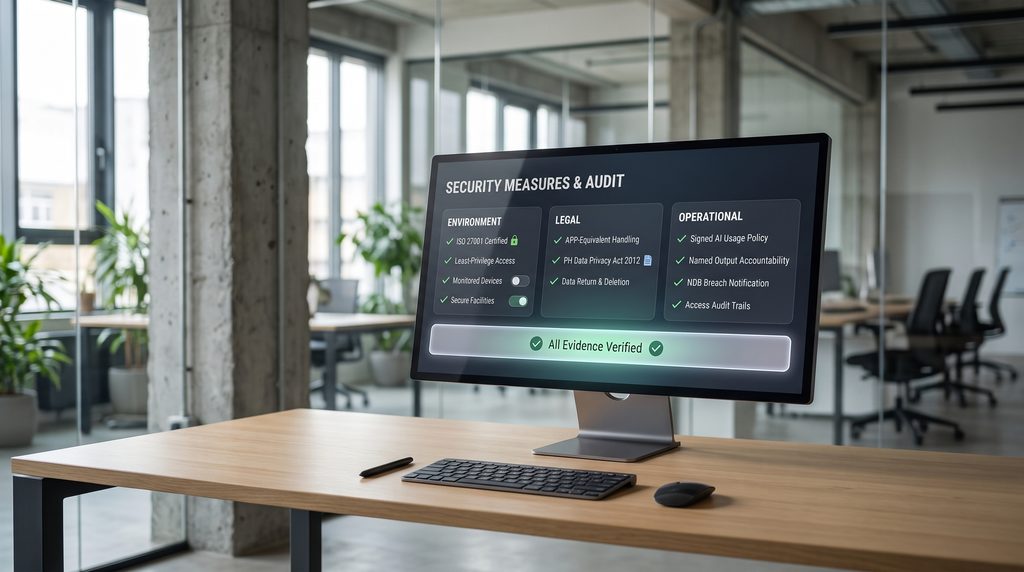
Evidence across three layers: environment, legal and operational. Ask for all of it in writing, and treat reluctance as your answer.
- Environment: certified security management (ISO 27001 or equivalent), access controls on a least-privilege basis, managed and monitored devices, and secure facilities
- Legal: contracts binding the provider and each team member to APP-equivalent data handling, confidentiality and IP assignment; coverage under the Philippine Data Privacy Act of 2012, enforced by the National Privacy Commission, whose obligations broadly align with international standards; and clean exit terms including return and deletion of your data
- Operational: a signed AI usage policy per team member, named accountability for every output, breach notification commitments that let you meet your own obligations under Australia’s Notifiable Data Breaches scheme, and audit trails showing who accessed what
Layered like that, an offshore seat is frequently easier to govern than a local one, because everything is explicit: the access is scoped, the rules are signed, and the evidence exists before anyone asks for it.
What this means before you sign
APP 8 turns a vague worry into a checklist: compliant environment, written AI data rules, and a contract that carries your APP obligations across the border. A provider who can evidence all three has answered the safety question; one who answers with adjectives has also answered it.
Hyvid’s safeguards exist as documents rather than assurances, from the signed AI usage policy to the environment controls and contractual terms. If you want to check them against this page’s checklist, review Hyvid’s security standards.
Frequently asked questions
Yes, when three controls hold: a provider operating secure, compliant environments; written rules governing what data enters which AI tools; and contracts addressing APP 8. Absent those controls, the accountability, and the risk, stays with you.
The Australian Privacy Principle for sending personal information overseas: take reasonable steps to ensure the overseas recipient handles it to Australian standards, and remain accountable if they do not. It applies to offshore teams the same way it applies to overseas cloud services.
Into approved, enterprise-configured tools under a written policy, yes, with de-identification where possible. Into free consumer tools, no, and your AI usage policy should say so explicitly.
Yes. The Data Privacy Act of 2012, enforced by the National Privacy Commission, imposes obligations broadly aligned with international standards, which is one reason global banks, insurers and healthcare organisations process sensitive work there.
Your contract should make the provider’s obligations and remedies explicit, and their notification commitments must be fast enough for you to meet your own Notifiable Data Breaches obligations. That is a question to settle in writing before engagement, not after an incident.