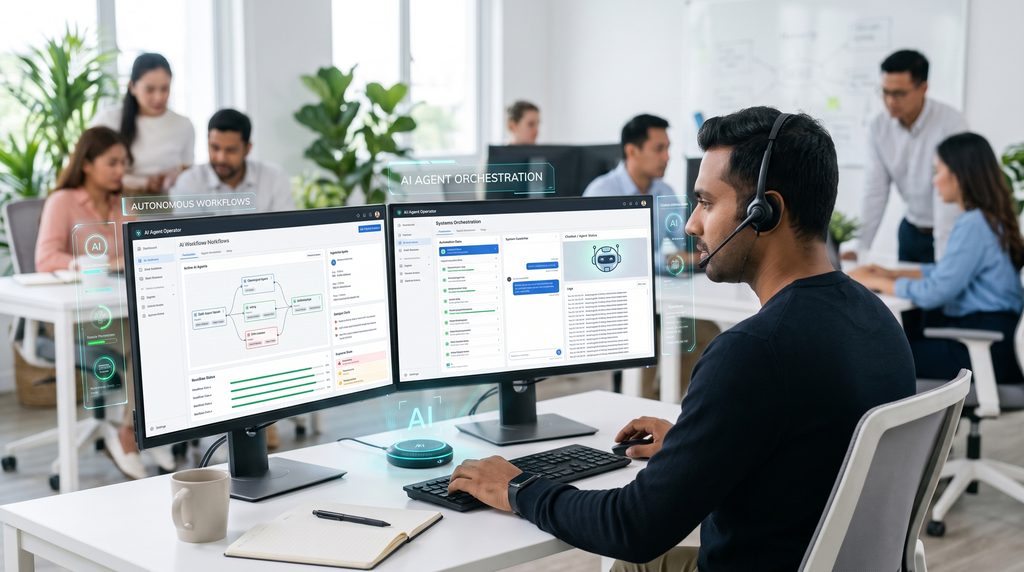
Quick answer: An AI operator is a team member who runs AI-enabled workflows: preparing inputs, running the tools, checking outputs and continuously improving the process. Unlike a traditional virtual assistant who executes tasks manually, an AI operator orchestrates systems, which means one person can manage volumes that once required a small team.
The title is new enough that no two job ads define it the same way, but the role itself is already working inside offshore teams, and it is the clearest picture available of where offshore work is heading: away from performing tasks, toward owning the systems that perform them.
What does an AI operator do day to day?
An AI operator spends the day moving work through AI-assisted pipelines and applying judgement at every point the pipeline cannot. A representative day in an administration-and-reporting seat looks like this:
- Morning triage: review overnight inputs (emails, orders, documents), run them through the drafting and categorisation tools, and clear the queue of AI-prepared outputs awaiting review
- Review and approval: check each AI draft against source data, correct what needs correcting, approve what ships, and route anything unusual to the right person
- Exception handling: work the items the tools flagged as uncertain, which is where most of the human judgement in the role lives
- Process improvement: log recurring corrections, tighten prompts and templates, and flag workflow steps that keep producing exceptions
- Reporting: maintain the output metrics (volumes, turnaround, error rates) that show the workflow’s health
Notice what is absent: hours of manual keying, copy-paste work and formatting. The production layer belongs to the tools. The operator owns everything the tools cannot: accuracy, exceptions, communication and improvement.
How is an AI operator different from a virtual assistant?

A virtual assistant executes tasks; an AI operator runs the system that executes them. The difference shows up in four places:
| Virtual assistant | AI operator | |
|---|---|---|
| Unit of work | A task performed manually | A workflow run end to end |
| Capacity | Bounded by hours in the day | Bounded by review capacity, several times higher |
| Value | Labour | Judgement, quality control and improvement |
| When volume doubles | You hire a second assistant | The same operator absorbs it, because the tools scale and the review step is fast |
The virtual assistant role is not disappearing so much as graduating. The administrative skills still matter; what changes is where they are applied. The best operators are frequently former assistants who know the work deeply enough to catch a wrong output at a glance.
What skills does an AI operator need?
Four, in descending order of difficulty to hire for: domain judgement, attention to detail, clear written communication, and AI fluency. Only the last one is quickly trainable, which is why it sits last.
Domain judgement is what makes review real: a bookkeeping operator must know what a wrong reconciliation looks like, a support operator must hear when a drafted reply strikes the wrong tone. Attention to detail is the discipline of checking against source rather than skimming. Written communication matters because the operator is the human interface of the workflow, explaining exceptions and escalations clearly. AI fluency, the part most job ads over-weight, is genuinely important and genuinely teachable in weeks.
A sample position description
Lift and adapt this for your first AI operator hire:
- Role: AI Operations Specialist (Administration and Reporting)
- Purpose: Own the daily running of AI-assisted workflows across administration, data processing and reporting, with accountability for the accuracy and timeliness of everything that ships
- Responsibilities: prepare and quality-check workflow inputs; review, correct and approve AI-drafted outputs against source data; handle and escalate exceptions; maintain prompts, templates and workflow documentation; report output, turnaround and error metrics fortnightly; propose one workflow improvement per month
- Requirements: 2+ years in administration, finance support or customer operations; demonstrated accuracy in detail-heavy work; clear written English; training on approved AI tools (provided); commitment to the AI usage policy
- Measures: volume completed, cycle time, error and rework rate, exceptions resolved, improvements shipped
What this means for how you hire
The AI operator is what the ‘AI-augmented team’ looks like at the level of a single seat: tools on the production layer, a person on everything that requires judgement, and a role description built around outcomes rather than tasks.
It is also the role profile Hyvid recruits and trains for by default across administration, finance, support, marketing and legal support seats. If this is the seat your workload is asking for, you can hire an AI operator through Hyvid with the training already done.
Frequently Asked Questions
A team member who runs AI-enabled workflows end to end: preparing inputs, running the tools, reviewing and approving outputs, handling exceptions and improving the process. The tools produce; the operator owns the outcome.
Not yet; you will see it alongside titles like AI operations specialist, workflow specialist and AI-enabled assistant. The responsibilities matter more than the label, and the sample position description above captures them.
A virtual assistant performs tasks manually and scales with hours; an AI operator orchestrates AI-assisted workflows and scales with review capacity, so one operator can cover volumes that previously needed several assistants.
Domain judgement, attention to detail and clear written communication, plus AI fluency, which is the easiest of the four to train. Hire for the first three; train the fourth.
Often, yes, and they are frequently the best candidates because they already know what good output looks like. A structured upskilling sequence plus a redesigned role description is usually the whole transition.