
Quick answer: The offshore roles gaining the most from AI are administration, bookkeeping, customer support, marketing and legal support, because each carries a heavy load of drafting, data handling and repetitive processing that AI now accelerates. An AI-equipped professional in these roles typically covers 30-50% more output than the same role without AI.
The pattern behind the list is simple. AI multiplies a role in proportion to how much of it is producing first drafts and processing structured information. The five roles below sit at the top because half or more of their week was historically exactly that, which is also why the uplift lands quickly rather than after a long transformation program.
Can offshore admin staff use AI?

Yes, administration is where the gains land fastest. An AI-equipped offshore administrator uses AI for routine administrative workflows. These tasks include inbox triage, meeting notes, document formatting, and data entry. However, the administrator still personally handles prioritization, client-facing tasks, and critical judgment calls.
This is where the shift from virtual assistant to AI operator becomes most visible. Instead of doing everything manually, the administrator runs automated workflows and quality-checks each output.
In recruitment businesses, this role manages candidate records, interview scheduling, and screening summaries. Similarly, in healthcare practices, it handles appointment coordination and patient records under required privacy controls.
How does AI change offshore bookkeeping?

AI moves the bookkeeper from keystrokes to control. Now, accounting platforms run routine tasks directly through AI tools. These tasks include invoice extraction, transaction categorisation, and first-pass reconciliation. Meanwhile, the bookkeeper reviews matches, tracks down anomalies, and handles exceptions. As a result, they personally ensure the accuracy of every report.
This approach delivers immediate practical benefits. For example, month-end closing that once took a week now compresses into days. Error rates drop because automated entries receive direct review instead of tired manual keying. Furthermore, freed-up hours go toward high-value work like cash flow tracking and supplier queries.
For retail and ecommerce operations, this pattern proves especially valuable. In fact, an exception-review model is the only reliable way to keep pace with high-volume order and payment reconciliation.
How does AI change offshore customer support?

AI handles the routine layer so the support professional handles the customers who need a human. With AI assistance, teams automate drafted replies, ticket categorisation, routing, and knowledge base upkeep. Meanwhile, the human team member owns complex resolutions, escalations, and tone judgement. Most importantly, they manage every interaction where empathy or discretion matters.
As a result, handling capacity rises without the quality drop common in pure chatbot deployments. This works because a person still signs off on anything non-trivial before it reaches the customer. For example, retail businesses benefit from this model during peak-season query surges. Similarly, healthcare settings apply the same structure to patient communications, where human review remains essential.
What AI tools do offshore marketing staff use?

Drafting and production copilots for copy and creative variants, analytics tools for reporting and campaign insight, research and summarisation tools for content planning, and scheduling platforms with AI assistance for distribution. The marketing professional directs all of it: the brief, the brand voice, the editorial judgement and the decisions about what actually ships.
The output change is concrete: a marketing coordinator who produced one campaign’s assets a week can direct AI-assisted production of several, with their time going to strategy, review and performance analysis instead of blank-page drafting. The quality risk, generic AI-sounding content, is exactly what the human direction layer exists to prevent.
What AI tools do offshore legal support staff use?
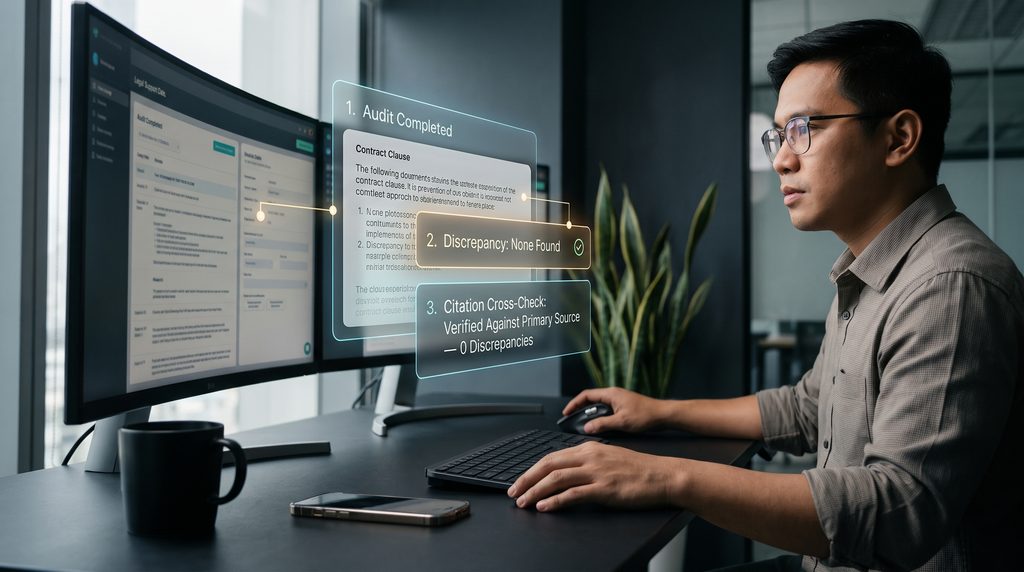
Document review and summarisation tools, first-draft correspondence and standard document preparation, matter administration and research assistants, always inside a strict review structure: the paralegal or legal assistant verifies everything against source documents, and qualified lawyers retain sign-off on anything with legal effect.
Legal support shows the human-in-the-loop model at its most disciplined, because the tolerance for fabricated detail is zero. Done properly, the gain is significant: document-heavy matters move faster, routine correspondence stops consuming lawyer time, and the offshore legal support professional becomes the workflow’s quality controller rather than its typist. This is the operating model behind Hyvid’s legal vertical.
Which role should you start with?
Start where your repetitive volume is highest, not where the org chart says you are most senior-short. The five roles above are ordered roughly by how quickly the uplift proves out: administration and bookkeeping show measurable gains within weeks because the workflows are structured and the output is countable; support, marketing and legal support follow as review standards are tuned.
The 30-50% uplift range is a function of workflow design, not magic in the tools. Roles reach the top of the range when the drafting and processing layer is genuinely handed to AI and the human’s week is rebuilt around review, exceptions and improvement, which is precisely how Hyvid structures every role across its legal, recruitment, healthcare and retail verticals. Every role comes AI-equipped and trained as standard. Browse the roles Hyvid can fill and map them against your own workload.
Frequently asked questions
Administration, narrowly, because almost its entire task load sits in the drafting-and-processing layer AI accelerates, and the gains appear within the first weeks. Bookkeeping is a close second with the most measurable output metrics.
No formal qualification exists or is needed. What matters is structured training on the specific tools, the workflow, and AI’s failure modes, plus the domain knowledge to catch errors. Good providers deliver this as standard before day one.
It is a typical range, not a promise, and it depends on workflow design. Roles where AI genuinely absorbs the drafting and processing layer reach it; roles where AI is bolted on as an occasional assist do not.
Yes. QA, software support and data roles follow the same pattern, with AI handling triage, test drafting and log analysis under human review. The five roles in this guide simply show the fastest, most universal gains for SMEs.
Each role uses a small stack suited to its work, drafting copilots, platform-embedded AI and analytics tools, but the operating model is identical across all of them: AI drafts and processes, the professional reviews, approves and improves.