Quick answer: PwC’s 2026 Global AI Jobs Barometer, released in June 2026, analysed more than one billion job advertisements across 27 countries and found that AI is splitting the labour market into two tracks. Roles where AI amplifies human expertise are growing twice as fast, with 42% faster wage growth, than roles AI simply automates. The companies winning with AI are hiring more, paying more, and growing faster. The lesson for business: use AI to multiply your people, not replace them.
The question every business leader has been asking since 2023 finally has a data-backed answer. Is AI destroying jobs, or creating them?
According to PwC’s 2026 Global AI Jobs Barometer, it’s doing both. And which side of the divide your business lands on depends entirely on how you deploy the technology.
What is the PwC 2026 Global AI Jobs Barometer?
The Global AI Jobs Barometer is PwC’s annual analysis of how AI is reshaping jobs, skills, wages and productivity worldwide. The 2026 edition, released on 15 June 2026, analysed more than one billion job advertisements across 27 countries and territories on six continents, combining labour market data with company financial and occupational task data. This year’s report also included a targeted analysis of 2.4 million entry-level roles in the US.
It’s one of the largest datasets ever assembled on AI’s real-world impact on work. Which makes its central finding hard to ignore.
What is the “two-track” labour market?
The Barometer’s headline finding is that AI is creating two distinct paths for jobs, and they’re moving in opposite directions.
Track one: professionalised roles. These are jobs where AI automates the routine tasks, so human judgement, expertise and decision-making become the core of the role. Think radiologists interpreting complex cases, or recruiters focusing on candidate assessment rather than CV screening.
Track two: democratised roles. These are jobs AI makes easier for non-experts to perform, lowering the barrier to entry. Think IT service managers or medical secretaries, where AI tools can now handle much of what previously required specialist knowledge.
The numbers tell the story:
- Professionalised roles are growing at twice the rate of democratised roles
- Wages in professionalised roles have grown 42% faster since 2021
- Skills requirements in the most AI-exposed jobs are changing more than twice as fast as in the least exposed jobs
In short, AI isn’t flattening the labour market. It’s stratifying it, and rewarding the roles built around human capability.
Are companies using AI actually cutting jobs?
No. This is the finding that surprises most people. The companies most exposed to AI are hiring faster than everyone else.
According to the Barometer:
- The most AI-exposed companies grew headcount by 52% since 2018, compared with 36% for the least AI-exposed
- Wage growth was also stronger at AI-forward companies: 24% versus 17%
- Companies in the most AI-exposed sectors recorded 34% productivity growth since 2018, against 24% for the least exposed
Then there’s what PwC calls the superstar effect. The top 20% of AI-exposed companies achieved average labour productivity growth of 163% since 2018, nearly five times the average for AI-intensive businesses overall.
PwC’s Global Chief AI Officer, Joe Atkinson, described the pattern as a new divide between business models. The companies seeing the greatest returns are using AI to “amplify human expertise, accelerate innovation and create entirely new sources of value”, and they’re pulling ahead of those focused purely on automation.
That distinction, amplification versus automation, is the entire game.
What skills are employers demanding in 2026?
Human ones. As AI absorbs routine and administrative work, employers are placing a premium on the capabilities machines can’t replicate: judgement, creativity, leadership and interpersonal skills.
At the same time, demand for AI capability itself is surging:
- Jobs requiring specific AI skills (machine learning, prompt engineering) grew 69%, against overall labour market growth of just 9%
- The wage premium for workers with AI skills climbed to 62%, up from 57% the previous year
- Technology, media and telecoms led all sectors in AI hiring intensity, with professional services close behind
The modern high-value worker isn’t a human competing with AI, or an AI replacing a human. It’s a human who knows how to work with AI. Exactly the model forward-thinking businesses are now building their teams around.
How is AI changing entry-level roles?
Dramatically. PwC’s analysis of 2.4 million US entry-level jobs found that the most AI-exposed junior roles are now seven times more likely to require traditionally senior skills like leadership, creativity and face-to-face interaction.
Openings for these “seniorised” entry-level roles have grown 35% since 2019, while other entry-level roles shrank by 10%.
The implication is significant. AI is removing the routine work that once served as an apprenticeship, which means businesses need new ways to build judgement and expertise in their people. Structured training, AI copilots that accelerate learning, and deliberate skill development are no longer nice-to-haves. They’re how the next generation of capability gets built.
What does the Barometer mean for businesses building offshore teams?
It validates a model many businesses are already moving towards: global talent, integrated with AI.

The Barometer makes three things clear for any business scaling its workforce:
- Amplification beats automation. The highest-performing companies aren’t using AI to shrink their teams. They’re using it to make every team member more productive, then reinvesting the gains into growth.
- AI-enabled talent commands a premium for a reason. With a 62% wage premium on AI skills, the smartest path for SMEs isn’t bidding for scarce local AI specialists. It’s building teams where every member is AI-trained and supported from day one.
- Human skills are the differentiator. Judgement, communication and adaptability are what separate professionalised roles from democratised ones. Talent selection and training should be built around these capabilities, with AI handling the routine layer underneath.
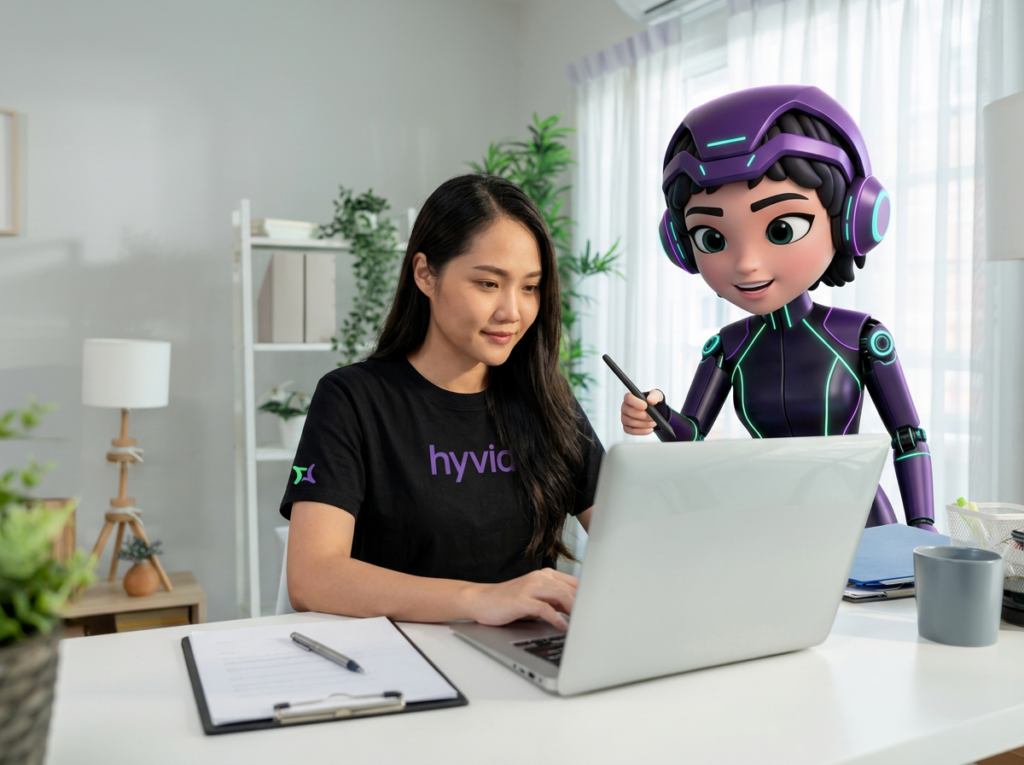
This is precisely the thinking behind Hyvid’s integrated model. Every Hyvid team member works as part of a human and AI unit, supported by a role-specific copilot, with AI agents available for high-volume, repetitive workflows. The result is the two-track advantage the Barometer describes: people focused on the work that requires judgement and expertise, with AI multiplying their output.
The businesses pulling ahead in PwC’s data aren’t choosing between people and AI. They’re combining them. That’s not a prediction anymore. It’s a billion job ads’ worth of evidence.
Frequently Asked Questions
It’s PwC’s annual research report tracking AI’s impact on jobs, skills, wages and productivity. The 2026 edition analysed over one billion job advertisements across 27 countries and territories, making it one of the largest studies of its kind.
No. The report found the most AI-exposed companies grew headcount by 52% since 2018, versus 36% for the least exposed. Companies using AI effectively are expanding, not contracting.
Professionalised jobs are those where AI handles routine tasks so human judgement becomes central, such as radiologists or recruiters. Democratised jobs are those AI makes easier for non-experts to perform. Professionalised roles are growing twice as fast, with 42% faster wage growth.
Workers with AI skills such as machine learning and prompt engineering now earn an average premium of 62%, up from 57% the previous year.
Entry-level roles most exposed to AI are seven times more likely to require senior-level skills like leadership and creativity. These “seniorised” roles have grown 35% since 2019, while other entry-level roles declined 10%.
By adopting the amplification model: building teams where AI handles routine work and people focus on judgement, expertise and client relationships. AI-integrated offshore teams give SMEs access to this model without enterprise-level cost or complexity.